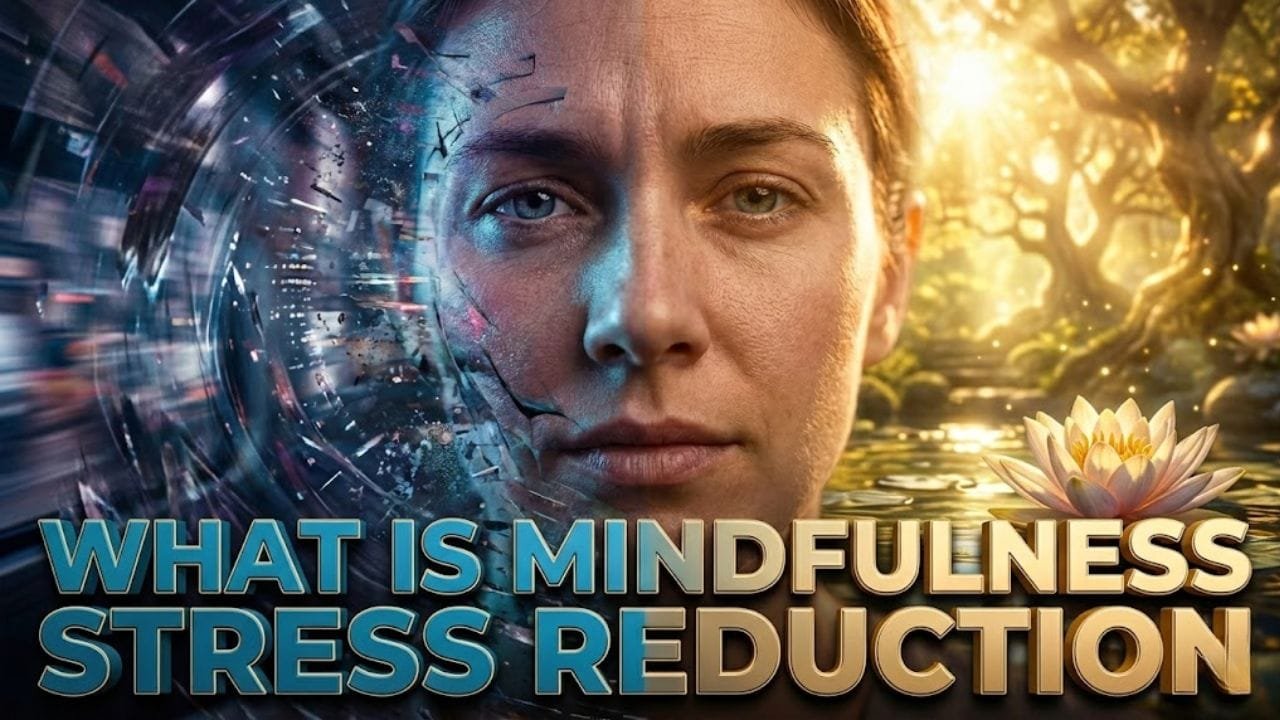
what is mindfulness stress reduction
Learn the science-backed framework that does more than manage stress—it's designed to physically change your brain's response to it.
In this article
😯 Are You Secretly Stressed?
Take this 5-question journey to find out your stress type — and learn how to melt it away with mindfulness 🧘♀️
What is Mindfulness-Based Stress Reduction (MBSR)? Unveiling the Path to Inner Calm
The Dawn of MBSR: A Revolution in Stress Management
In the relentless hum of modern existence, where deadlines loom large and the mental bandwidth is stretched thinner than a yoga mat on a tightrope, the concept of stress has become an unwelcome, yet ubiquitous, companion. We navigate a world that often glorifies busyness, mistaking constant activity for productivity and equating resilience with the ability to simply endure. But what if there was a more sustainable, a more profound way to interact with the challenges life throws our way? Enter Mindfulness-Based Stress Reduction, or MBSR. Born from the visionary mind of Jon Kabat-Zinn in the late 1970s at the University of Massachusetts Medical Center, MBSR isn’t just another self-help trend; it’s a rigorously studied, evidence-based program that offers a potent antidote to the corrosive effects of chronic stress.
Play this while you read
At its core, MBSR is an 8-week intensive training program designed to cultivate a profound and transformative shift in how individuals relate to stress, pain, and illness. It’s not about eradicating stress – an often futile endeavor given its intrinsic role in signaling danger and motivating action – but rather about transforming our relationship with it. Think of it like learning to surf: the waves will always come, but with the right skills and awareness, you can learn to navigate them with grace rather than being overwhelmed and capsized. MBSR equips you with these surfing skills for the waves of life.
The genesis of MBSR is deeply rooted in a synthesis of ancient contemplative traditions, particularly Buddhist meditation, and contemporary Western medicine and psychology. Kabat-Zinn, a dedicated meditator and molecular biologist, observed the potential of mindfulness practices to not only alleviate suffering but also to foster a deeper sense of well-being, even in the face of physical and emotional adversity. He recognized that while the medical establishment was adept at treating diseases, it often overlooked the crucial role of the patient’s inner experience and their capacity for self-regulation. MBSR emerged as a bridge, bringing the wisdom of mindful awareness into the clinical setting, offering a secular, accessible, and practical approach to healing and coping.
The program’s structure is intentionally immersive, demanding a commitment that fosters deep learning and integration. Typically delivered in a group setting, facilitated by certified instructors, MBSR involves weekly 2.5-hour sessions for eight weeks, culminating in a full-day retreat during the seventh week. This sustained engagement is critical. It’s akin to learning a new language or mastering a musical instrument; consistent practice over time is what builds proficiency and allows for genuine transformation. The program encourages participants to dedicate 45-60 minutes daily to formal mindfulness practices, further solidifying the learned skills and integrating them into the fabric of daily life.
The Pillars of MBSR: Cultivating Present Moment Awareness
1. The Practice of Mindfulness Meditation: The Breath as an Anchor
The cornerstone of MBSR is mindfulness meditation. This isn’t about emptying the mind or achieving a state of blissful oblivion. Instead, it’s about cultivating a gentle, non-judgmental awareness of the present moment – whatever arises, be it thoughts, feelings, bodily sensations, or external stimuli. The most foundational practice is often the breath awareness meditation. Your breath is a constant, an ever-present anchor in the turbulent seas of experience. By bringing your attention to the sensation of the breath, you learn to observe the natural rhythm of inhalation and exhalation, noticing the subtle rise and fall of your chest or abdomen. When the mind inevitably wanders – and it will, that’s its nature – the practice isn’t about criticizing yourself. It’s about noticing that the mind has wandered, gently acknowledging it without judgment, and then guiding your attention back to the breath. This repetitive act of noticing and returning is the very essence of training the mind. Neurobiologically, this repeated redirection of attention strengthens the prefrontal cortex, the brain region associated with executive functions like attention control, emotional regulation, and self-awareness. It’s like doing reps at the gym for your brain, building its capacity for focus and reducing the automatic reactivity that often fuels stress.
2. Body Scan Meditation: Reconnecting with the Physical Self
Another central practice is the body scan. This involves systematically bringing awareness to different parts of the body, from the toes all the way up to the crown of the head. The intention is not to change or fix anything, but simply to notice the sensations present in each area. You might notice warmth, coolness, tingling, pressure, tightness, or perhaps nothing at all. The key is to approach these sensations with curiosity and acceptance. For many who live with chronic pain or discomfort, the body scan can be a challenging yet profoundly liberating practice. It helps to disentangle the physical sensation from the emotional and cognitive reaction to it. Instead of perceiving pain as an enemy to be fought, one can learn to acknowledge its presence with a greater degree of equanimity, potentially reducing the secondary suffering that arises from resistance and fear. This practice taps into interoception, the sense of the internal state of the body, which is crucial for emotional regulation and self-awareness. Research in neuroplasticity suggests that practices like the body scan can lead to changes in brain structure and function, particularly in areas associated with sensory processing and emotional awareness.
3. Mindful Movement: Integrating Awareness into Action
MBSR also incorporates mindful movement, often through gentle yoga or stretching. This isn’t about achieving pretzel-like poses or pushing your body to its limits. Rather, it’s about bringing the same quality of present moment awareness cultivated in seated meditation to physical activity. You’re encouraged to notice the sensations of movement, the stretch in your muscles, the balance of your body, and to move in ways that feel respectful and attuned to your body’s signals. This practice can be particularly beneficial for individuals who find prolonged stillness difficult, or for those seeking to improve their relationship with their physical form. It helps to dissolve the mind-body disconnect that is so common in our culture, fostering a greater sense of integration and embodiment. This mindful engagement with movement can also help to release stored tension and stress held within the musculature, offering both physical and psychological release.
4. Informal Mindfulness Practices: Weaving Awareness into Daily Life
Beyond the formal practices, MBSR places significant emphasis on cultivating “informal mindfulness.” This means bringing the practice of paying attention with intention and without judgment to everyday activities. This could be anything from mindfully eating a meal, noticing the tastes, textures, and smells, to mindfully brushing your teeth, feeling the sensations, or mindfully walking, paying attention to the feeling of your feet on the ground. These informal practices are where the real transformation often takes hold, as they demonstrate that mindfulness isn’t confined to a cushion or a yoga mat, but can be a way of being in the world. This continuous, gentle awareness acts as a buffer against the automatic pilot mode that often leads to stress and burnout. It’s about learning to inhabit your life more fully, one moment at a time.
The Science Behind the Serenity: MBSR and the Brain
The efficacy of MBSR is not merely anecdotal; it is supported by a robust body of scientific research, particularly in the fields of neuroscience and psychology. Studies using fMRI (functional Magnetic Resonance Imaging) have shown that regular mindfulness practice can lead to significant changes in brain structure and function. One of the most consistent findings is an increase in gray matter density in areas associated with learning, memory, self-awareness, and compassion, such as the hippocampus and the posterior cingulate cortex. Conversely, a reduction in gray matter density has been observed in the amygdala, the brain’s “fear center,” which is implicated in the stress response. This suggests that mindfulness training can literally re-wire the brain, making individuals less reactive to stressors and more resilient in the face of adversity.
Furthermore, MBSR has been shown to influence physiological markers of stress. Research has documented reductions in cortisol levels (the primary stress hormone), decreased blood pressure, and improved immune system function in individuals who have completed MBSR programs. This highlights MBSR’s holistic impact, addressing stress not just at a psychological level but also at a deep physiological one. The ancient wisdom of paying attention to the present moment, it turns out, has a profound and measurable impact on our biology, offering a powerful toolkit for enhancing health and well-being.
The psychological underpinnings of MBSR are equally compelling. By fostering non-judgmental awareness, MBSR helps individuals to de-center from their anxious thoughts and worries. Instead of getting caught in a spiral of rumination, participants learn to observe their thoughts as transient mental events, like clouds passing in the sky. This shift in perspective can significantly reduce the impact of negative thinking patterns, which are often a major contributor to stress and emotional distress. Moreover, MBSR cultivates self-compassion, encouraging participants to treat themselves with the same kindness and understanding they would offer a dear friend. This is particularly crucial for individuals who are prone to self-criticism or perfectionism, as it offers a pathway to greater self-acceptance and emotional healing.
Who Can Benefit from MBSR? A Universal Tool for Modern Living
The beauty of MBSR lies in its broad applicability. While initially developed for individuals with chronic pain and illness, its benefits have proven to extend to a wide range of populations and conditions. Anyone experiencing the pervasive effects of stress can find value in MBSR. This includes:
- Individuals struggling with chronic stress, anxiety, and depression.
- People dealing with chronic pain, illness, or medical conditions.
- Those experiencing burnout from work or personal life demands.
- Caregivers who are constantly under emotional and physical strain.
- Students facing academic pressures.
- Professionals in high-stress environments.
- Anyone seeking to enhance their overall well-being, emotional resilience, and quality of life.
The program doesn’t require any prior experience with meditation or a particular belief system. It is a secular program, accessible to people of all backgrounds and faiths. The core principles are universally applicable, offering a pathway to greater inner peace and coping capacity in the face of life’s inevitable challenges.
The Transformative Journey: What to Expect from MBSR
Embarking on an MBSR program is a journey of self-discovery and transformation. Participants often report a profound shift in their perspective, a greater sense of agency over their lives, and an enhanced capacity to navigate difficult emotions. You might find yourself less reactive to everyday annoyances, more present in your relationships, and more attuned to your own needs and well-being. The program fosters a sense of community among participants, as they share their experiences and support each other’s learning. This shared journey can be incredibly validating and empowering, reminding individuals that they are not alone in their struggles.
While the 8-week program provides a structured foundation, the skills learned in MBSR are meant to be integrated into daily life, continuing to unfold and deepen over time. It’s not a quick fix, but a sustainable practice that empowers individuals to cultivate resilience, cultivate inner calm, and live a more engaged and meaningful life. The journey is one of cultivating a kinder, more aware relationship with oneself and with the world.
Informational Purposes Only. This content is for educational purposes only and does not constitute medical advice. Always consult with a qualified healthcare professional for any health concerns or before making any decisions related to your health or treatment.
About this article. This is a guide to a contemplative and symbolic practice, not to medicine. Nothing here is medical, psychological or therapeutic advice, no practice on this page treats or prevents any condition, and none of it replaces care from a qualified professional. If you are living with persistent pain, exhaustion, low mood, anxiety, insomnia or any symptom that worries you, please talk to a doctor — and never stop or change a prescribed medication because of something you read here. If you have epilepsy or a seizure disorder, check with your doctor before using pulsed tones or binaural beats.
Read this next
What Is 528 Hz Miracle Frequency For Holistic Healing?
Unleash physical and emotional healing with our Positive Transformation 528Hz Miracle Frequency. Experience de…
11 min read174 Hz Alpha Waves Sound Bath: Deep Healing & Pain Relief
Immerse yourself in our 174Hz Alpha Waves Sound Bath, a blend of deep healing frequencies and alpha waves, off…
14 min read600 Hz Miracle Frequency: Healing From Heartbreak Guide
Experience the power of Pure Love with our 600Hz Miracle Frequency healing sessions. Transform your energy, ov…
17 min read