Throat Chakra Meditations
A throat chakra meditation is for the sentence you have been editing for a week. Vishuddha sits at the throat, and this tradition places expression there — getting what is inside you accurately to the outside. Its failure mode is not shouting. It is silence that gets called keeping the peace.
| Sanskrit | Vishuddha — “especially pure” |
| Where | The throat |
| Colour | Blue |
| Element | Ether |
| Governs | Speech, honesty, listening, self-expression |
| Blocked | Rehearsing conversations you never have, over-explaining, a tight throat |
| Balanced | You say the hard thing and it lands as kindness |
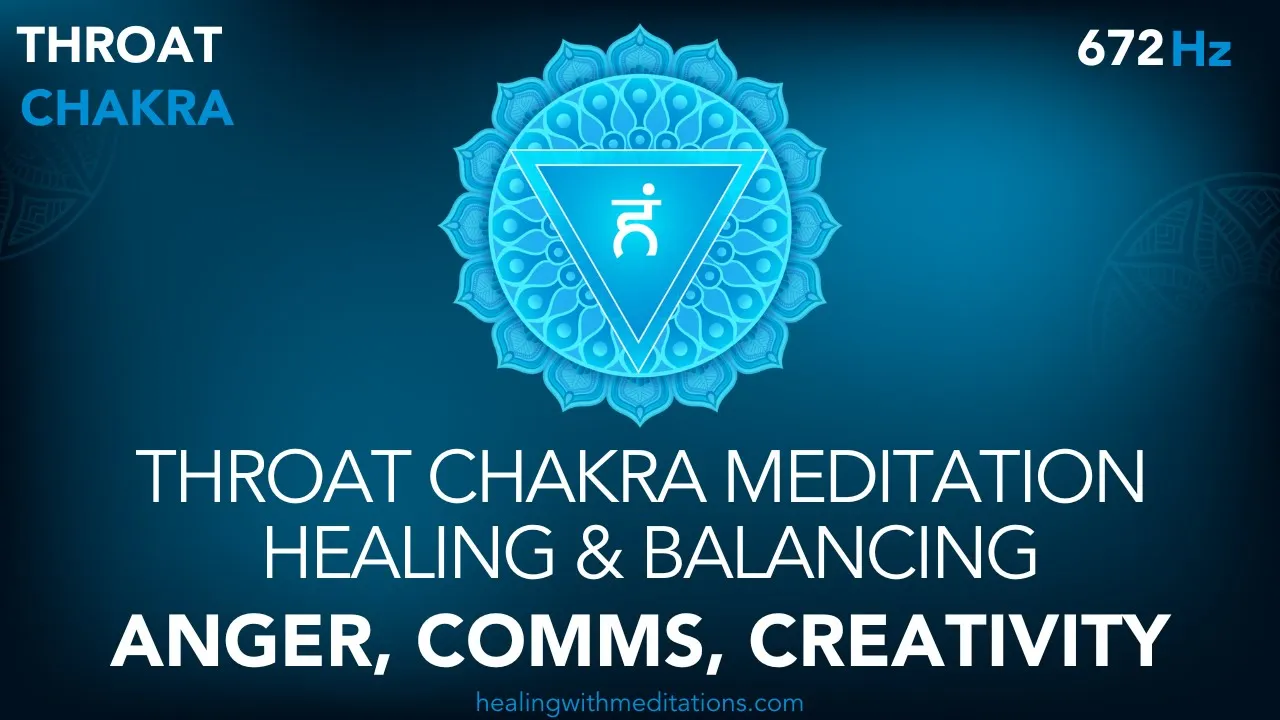
| Tone traditionally used | 741 Hz, and 672 Hz in some modern practice — conventions, not measured effects |
What a throat chakra meditation actually works on
The throat is unusual among the centres because the practice is not really the sitting. It is the saying. Anything that uses the voice counts — reading aloud, humming, singing badly in the car — and the tradition treats those as the work rather than the warm-up.
What keeps this centre closed is almost always specific: one conversation, one person, one thing that has gone unsaid long enough to become structural.
How to tell whether yours needs attention
Pick whichever is closest to your week.
The classic block. The conversation has been held perfectly in your head a dozen times.
Start with: saying one sentence of it out loud, alone, today. The mouth needs to have made the shape.
Read as the throat working too hard. Softening and justifying until the point is buried.
Start with: writing the message, then deleting the first and last sentence. They are usually the apology.
The physical version, often noticed before the emotional one.
Start with: humming for two minutes. If tightness or hoarseness persists, see a doctor — the throat is also just a throat.
Not evasion — under-expression. The inside and the outside have drifted apart.
Start with: one honest answer to “how are you” this week.
The over-firing version. Speech as discharge rather than communication.
Start with: a pause before answering. Three seconds is enough to change what comes out.
How to practise it
Sit upright and let the jaw be loose. Hum on each exhale — low, unforced, so you feel it in the throat and lips. Two or three minutes is plenty; more makes people hoarse.
Then read a paragraph aloud, and finish by saying one true sentence you would normally soften. The humming prepares the instrument; the sentence is the practice.
What this practice is not
It is not a treatment for a physical throat problem, and it is not a substitute for the conversation itself. Persistent hoarseness, pain on swallowing, or a lump you can feel needs a doctor, not a practice.
The guides below
Each one is a single practice, with a meditation you can play while you read.
What the evidence shows — and what it does not. Music and binaural beats have measurable effects: controlled studies report reduced anxiety and lower perceived pain, alongside EEG changes during listening. Those results come from small, varied studies, so treat them as promising rather than settled. There is no peer-reviewed evidence that any single frequency performs a specific biological task. Pick a tone because the sound suits you, not because a number is acting on your cells.
About these guides. Chakra work is a contemplative and symbolic tradition, not medicine. Nothing here is medical or psychological advice, none of it treats or prevents any condition, and it does not replace care from a qualified professional. If you are living with persistent pain, exhaustion, low mood, anxiety or insomnia, please talk to a doctor — and never stop a prescribed medication because of something you read here. If you have epilepsy or a seizure disorder, check with your doctor before using pulsed tones or binaural beats.
Throat Chakra Meditation: 672 Hz For Better Communication
Discover improved communication skills with our 672 Hz Throat Chakra Healing. Experience enhanced verbal expre…
11 min readFind Peace: 672 Hz Throat Chakra Meditation for Anger Relief
Discover the power of 672 Hz Throat Chakra Miracle Frequency for anger relief. Join our community for guided m…
12 min readHow To Master Decisions: 672 Hz Throat Chakra Meditation
Enhance your decision-making skills with our 672 Hz Throat Chakra Meditation. Experience clarity, build confid…
14 min read672 Hz Miracle Frequency: Throat Chakra Meditation Guide
Experience spiritual growth with Faith & Knowledge Meditation, 672 Hz Miracle Chakra Frequency for throat…
11 min read672 Hz Throat Chakra Healing: Release Judgment & Self-Love
Experience self-acceptance & love with a 672 Hz throat chakra meditation, releasing judgment & critici…
13 min readHeal Addiction: 672 Hz Throat Chakra Meditation Guide
Experience freedom from addiction with our Throat Chakra Meditation at 672 Hz. Unlock your true voice and over…
12 min readUnlock Creativity: 672 Hz Miracle Throat Chakra Guide
Unlock your creativity with our 672 Hz Chakra meditation. Access your inner artist, overcome mental blocks, an…
17 min readMeditation: 6 Effective Ways To Make Your Dreams Come True
Embark on a journey of dream realization with our 672 Hz Miracle Chakra Frequency. Boost your creativity, enha…
14 min readThroat Chakra Meditation: Heal & Balance With 672 Hz
My Throat Chakra is balancing, opening and healing with miraculous frequency.... Anger, Communication, Creativ…
12 min read