Aura Colours: What Each One Means, and What the Camera Is Really Doing
Every aura colour, its shadow side and what the shade changes — plus a behaviour-based aura colour quiz and an honest account of what aura cameras and Kirlian photography actually measure.
In this article
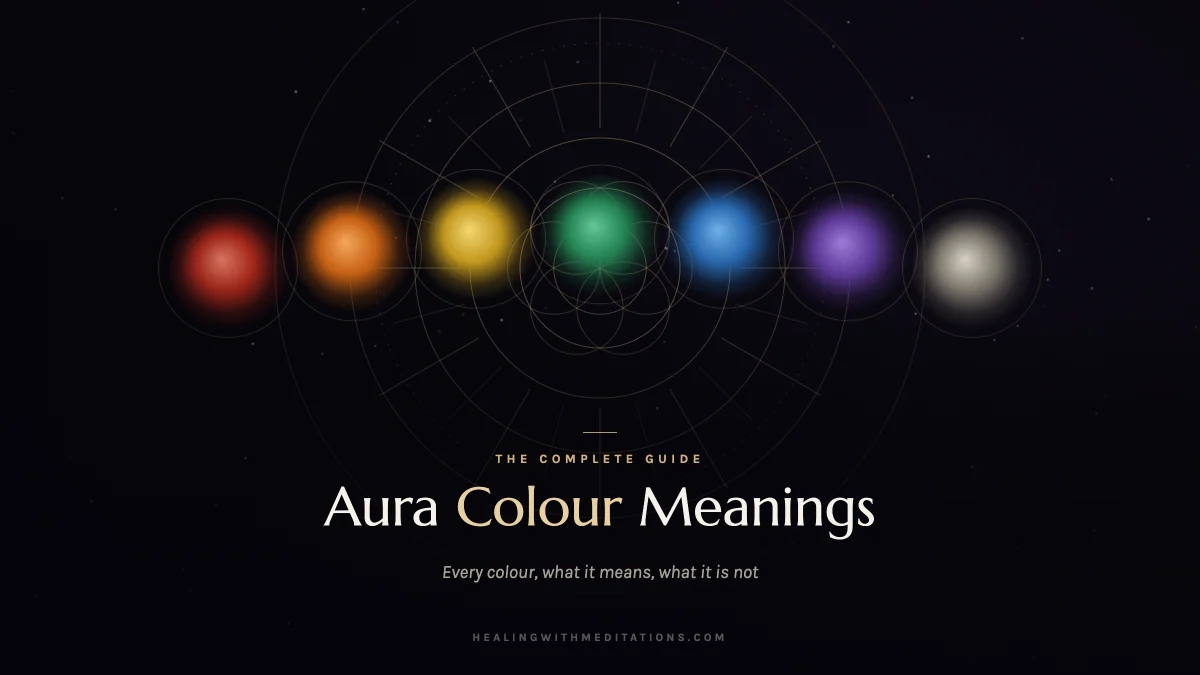
Aura colours are the vocabulary of a symbolic tradition, not a measurement. Each colour carries a settled meaning that has been remarkably stable for a century, and reading them is a genuinely useful way of naming how someone comes across. What no aura colour is, is something anyone has photographed, detected or measured — including the camera at the psychic fair, which this page explains in full.
Which aura colour matches you?
Six questions about how you actually behave, not about which colour you like. You get a main colour and a second one, because almost nobody is a single colour.
The aura colour chart
Every colour, what it is read as, and the shadow side that most charts leave off. Each row links to the full reading.
| Colour | Read as | The shadow side |
|---|---|---|
| Red | Force, appetite, physical presence, the will to start | Intensity that reads as anger. Burning through the people around you |
| Orange | Appetite for experience, sociability, creative play | Scatter. Five things started, none finished |
| Yellow | A quick, curious, optimistic mind | The same quickness with nowhere to go becomes anxiety |
| Green | Repair, growth, care, the person who mends things | Mending everyone except yourself |
| Blue | Expression, calm truth-telling, being confided in | Carrying everyone’s problems and telling nobody yours |
| Purple / violet | Perception, intuition, seeing past the obvious | Distance. The most over-claimed colour in the spectrum |
| White | Clarity, protection, transition. All colours at once | Emptiness, or a field so depleted there is nothing left to show |
| Black | Exhaustion, grief, something held and not put down | Being told it is a curse, by someone selling the removal |
| Pink | Affection, tenderness, new love, uncomplicated warmth | Read as naivety. Often a temporary state rather than a base colour |
| Brown | Groundedness, practicality, attachment to the physical | Read as stuck, or as clinging to security past its usefulness |
| Grey | Neutrality, withholding, a field with the volume turned down | Almost always read as temporary. Grief, illness, or simply a bad month |
| Silver | Receptivity, abundance, a field described as reflective | The rarest and least consistently described colour in the tradition |
Nobody has a single colour. Every serious reader in the tradition describes a field as a main colour with others at the edges, and describes it as changing — over a day, over a difficult year, over a recovery. A page that hands you one permanent colour and a personality to match is doing astrology with different vocabulary. Read your main colour, then read the second one, and pay attention to which parts of each you actually recognise.
What the shade changes
This is the part that carries most of the actual information and the part most charts skip entirely. Within a colour, the tradition reads brightness and clarity as the state, and the hue as the type.
| Quality | What it is read as |
|---|---|
| Bright and clear | The colour working well. Whatever it is, you are doing it on purpose |
| Pale or washed out | The same quality, depleted. Usually read as tiredness rather than as a different colour |
| Muddy or clouded | The shadow side. Green becomes resentment, red becomes anger, blue becomes withholding |
| Dark or heavy | Held rather than expressed. Something not put down |
| Patchy or broken | Read as conflict — the colour saying one thing and behaviour saying another |
So “dark green” is not a separate colour with its own personality. It is green with something in the way, and the reading is about what got in the way. That single rule makes most colour charts much shorter and much more useful.
What an aura camera is actually measuring
This is the most interesting thing on the page, and almost nobody writes it down honestly.
The machine at the psychic fair or the wellness expo is almost always an AuraCam or one of its imitators, and it is not photographing anything around you. You place your hands on two metal plates. Those plates take two ordinary readings: galvanic skin response — how easily your skin conducts a tiny current, which changes with sweat and therefore with arousal, the same principle a lie detector uses — and skin temperature at a few contact points.
Those numbers are fed into software, which maps them onto a colour palette using a lookup table the manufacturer chose. The colour is then composited over an ordinary photograph of you. The camera takes a normal picture; the software paints the halo on afterwards.
What follows from that. If you sit down hot, nervous, or with damp hands after carrying shopping, you will get a different colour than if you sit down cool and calm ten minutes later. Nothing outside your body was measured, because nothing outside your body was ever being measured. The reading is a stylised display of your skin conductance, and the colour assignments were a design decision.
The older technique, Kirlian photography, is a different thing again and equally well understood. Put an object on a photographic plate, apply a high-voltage field, and you get a corona discharge glowing at its edges. It is real physics, it photographs beautifully, and what it images is the ionisation of air and moisture at the surface — which is why a freshly cut leaf gives a bright corona and a dried one gives almost nothing, and why the effect changes if you do it in a vacuum. It is not a life force. It is electricity meeting damp air.
None of this means the vocabulary is worthless. It means the vocabulary is a vocabulary. If someone tells you their machine has scientifically confirmed your indigo aura, they are describing a lookup table.
Can you actually see an aura?
People do see something, reliably, and there is a decent account of what.
Stare at a fixed point beside someone’s head against a plain background for thirty seconds and a soft outline usually appears — often a complementary colour to what you were staring at. Two well-documented effects account for most of that. The first is the afterimage: fatigue the cones responding to one colour and the opposite colour appears at the edges. The second is Troxler fading: hold your gaze steady enough and stationary parts of the periphery grey out entirely, which makes whatever remains at the boundary look like it is glowing.
That is not a debunking of the practice, it is a description of the mechanism. Soft-focus aura viewing is a genuine perceptual exercise, and it teaches you to look at a person slowly and without a running commentary, which is most of what it is for. Our five-step guide to seeing auras covers the technique properly.
The one test that has been run. Where people claiming to see auras have been asked to say which of several screens a person is standing behind — a simple test that a genuinely visible field would pass easily — the results have not exceeded chance. It has not been done often, and it is worth knowing rather than ignoring. It also does not touch the value of the practice as a way of paying attention.
How to read a colour honestly
- Start with behaviour, not preference. Your favourite colour is not your aura colour, and the quiz above is built on how you act for exactly that reason.
- Read the shadow side first. Every colour above has one, and it is the half that tells you something you did not already know.
- Take the second colour seriously. The interesting reading is nearly always the tension between the two, not the headline.
- Ask what changed. If a colour has shifted, the useful question is what happened in the last year, not what the new colour means in the abstract.
- Walk away from fear. Anyone who reads your colour and then offers to clear, remove or fix it for money is running a sales script that predates all of us. There is nothing in the tradition that requires payment to change.
Where to go next
- What is an aura? — where the idea comes from and what it is claimed to be.
- How to see auras — the soft-focus technique, step by step.
- Aura cleansing — seven methods, what each one is actually doing.
- Chakras — the system aura colours are usually mapped onto, and where the mapping breaks.
Frequently asked questions
What do aura colours mean?
Each colour carries a settled meaning in the tradition: red is force and physical presence, orange appetite for experience, yellow a quick mind, green repair, blue expression, purple perception, white clarity or transition, black exhaustion or something held. The shade matters as much as the colour — bright means the quality is working, muddy means its shadow side is.
How do I know what my aura colour is?
There is no test that measures it, so what is actually on offer is a structured reading of how you behave — which is what the quiz on this page does. Read your main colour and your second colour, and notice which specific lines you recognise. If nothing lands, the reading is not describing you.
Can your aura colour change?
In the tradition, yes, and it is expected to. Readers describe a main colour that is fairly stable with edge colours that shift over days, and a whole field that can change through grief, illness, recovery or a change of life. A page that gives you one permanent colour is not describing the practice accurately.
What is the rarest aura colour?
Nobody can say, because nobody has counted anything. There is no register of aura colours and no instrument that detects them, so any claim about rarity is a claim about which colours readers report most often — and that varies by reader. Silver and pure white are the two most often described as rare in the literature.
Do aura cameras actually work?
They work as machines, but not as aura detectors. An aura camera measures galvanic skin response and skin temperature through hand plates, maps those numbers to colours using the manufacturer’s lookup table, and composites the colour over an ordinary photo of you. Nothing outside your body is measured. Sit down hot or nervous and you get a different colour.
What is Kirlian photography?
A technique in which an object is placed on a photographic plate in a high-voltage field, producing a corona discharge at its edges. The physics is well understood: it images the ionisation of air and surface moisture, which is why a fresh leaf glows and a dried one barely does. It is a real and beautiful effect, but it is not photographing a life force.
Why do I see a glow around people when I stare?
Two ordinary perceptual effects account for most of it. Afterimages appear in the complementary colour when the cones responding to one colour fatigue, and Troxler fading makes stationary parts of the peripheral field grey out when your gaze is held steady — which makes whatever remains at the boundary look like it is glowing. Knowing the mechanism does not spoil the exercise.
Is a black aura bad?
No, and it is not a curse. In the tradition it is read as exhaustion, grief, or something being carried and not set down — a state rather than a verdict, and one that changes. Anyone who tells you a black aura is a curse and offers to remove it for a fee is running a sales script, not a reading.
What does it mean if I have two aura colours?
That is the normal case. Almost every reading in the tradition describes a main colour with a second showing at the edges, and the useful part is usually the tension between them — a blue main colour with red at the edges reads very differently from blue with green.
Are aura colours the same as chakra colours?
They overlap and they are not the same system. The seven chakra colours are a fixed sequence tied to positions in the body; aura colours are read as a whole field and include colours with no chakra equivalent, such as pink, brown, grey and silver. The mapping between them is a modern convenience rather than an old tradition.
What is my aura colour by birthday?
There is no traditional basis for one. Charts that assign aura colours by birth date are borrowing the format of sun-sign astrology, and the assignments differ from site to site because each one made them up. If you want a reading built on your birth date, the life path number is at least a system with rules everyone agrees on.
Is there any scientific evidence for auras?
No. No instrument detects a field of the kind described, and in the tests that have been run, people claiming to see auras have not identified hidden subjects better than chance. What is real is that people read each other constantly and accurately from posture, expression and tone — and that aura language is a vivid way of naming that. Treat it as vocabulary, not measurement.
About this article. Aura reading belongs to a spiritual and symbolic tradition, not to medicine or science. Nothing here is a diagnosis or medical, psychological or therapeutic advice, and no practice on this page treats any condition. Persistent exhaustion, low mood, anxiety or any symptom that worries you belongs with a qualified professional — please do not delay care because of something you read here, and never stop a prescribed medication on the strength of it. If a reading is ever used to frighten you, or to sell you an urgent clearing or removal, treat that as a reason to walk away.
Read this next
What Does a Yellow Aura Mean? Confidence, Shades & Anxiety
What a yellow aura means: confidence, curiosity and quick thinking — plus how to tell bright yellow from the a…
6 min readWhat Does a Purple Aura Mean? Violet, Indigo & Lavender
What a purple aura means: intuition, imagination and meaning — plus the difference between violet, indigo and…
7 min readWhat Does an Orange Aura Mean? Creativity, Shades & Scatter
What an orange aura means: creativity, appetite and sociability — plus what muddy orange changes, and the patt…
6 min read