Chakra Frequencies: The Tone for Each Chakra (and Why Sources Disagree)
The Hz for all seven chakras in both charts side by side, where those numbers actually came from, why no two sources agree, and how to use a tone properly.
In this article
Every chakra chart online gives a different set of numbers, and none of them come from the tradition. Chakras are described in Sanskrit texts going back a thousand years. Hertz was defined in 1930. So any frequency assigned to a chakra was assigned in the last century or so, by someone, and different someones chose differently.
That does not make the practice useless — a steady tone is genuinely good at holding attention still, which is most of what a meditation needs. It does mean you should know which chart you are using and stop looking for the correct one.
Play this while you read
The short version: the two sets in wide use are the Solfeggio tones and the higher chakra-tone set that includes 720 Hz for the third eye. Neither is older than living memory, neither is standardised, and no clinical evidence links a specific frequency to a specific chakra. Pick a set, stay with it, and judge it by whether you actually sit down.
What the evidence shows — and what it does not. Music and binaural beats do have measurable effects: controlled studies report reduced anxiety and lower perceived pain, alongside changes in EEG activity during listening. Those results come from small and varied studies, so treat them as promising rather than settled. What is not supported is the idea that one exact frequency performs one exact biological task. There is no peer-reviewed evidence that 528 Hz repairs DNA, and the “Solfeggio” set was assembled in the late 1990s rather than inherited from medieval chant. Choose a tone because the sound suits you and helps you settle — that part is real — not because a number is doing something measurable to your cells.
The frequencies, side by side
Two charts, the two you will meet most often. Read across, not down.
| Chakra | Solfeggio · Chakra-tone set |
| Root — Muladhara | 396 Hz · 432 Hz |
| Sacral — Svadhisthana | 417 Hz · 480 Hz |
| Solar plexus — Manipura | 528 Hz · 528 Hz |
| Heart — Anahata | 639 Hz · 594 Hz |
| Throat — Vishuddha | 741 Hz · 672 Hz |
| Third eye — Ajna | 852 Hz · 720 Hz |
| Crown — Sahasrara | 963 Hz · 768 Hz |
They agree on exactly one number — 528 Hz — and even that is coincidence rather than corroboration. If you have been switching between charts wondering why nothing lines up, this is why.
Tap any chakra above for what it governs and how a block in it actually shows up, or start with all seven together →
Where the numbers came from
The Solfeggio set was proposed in the 1970s by Joseph Puleo, who said he derived the six tones from a numerological reading of a Latin hymn to John the Baptist. Later writers extended the six to nine and mapped them onto the chakras. It is a modern construction with a medieval story attached, and the medieval part does not survive checking — the historical Solfeggio syllables were a teaching aid for singing, not a list of frequencies.
The chakra-tone set, the one that puts 720 Hz at the third eye, is built differently: it starts from a base tone and moves up in musical intervals, so the numbers form a proportional series rather than a list. It is internally tidier. It is also modern.
Neither has been tested for the thing it claims. There is real research on sound and relaxation — slow, steady, predictable sound lowers arousal, and people breathe more slowly when they listen to it. That research says nothing about which Hz, and nothing about chakras.
What are you actually using it for?
The choice that matters is not the number. It is what you want the session to do.
Lower tones, longer session, volume down. Root or sacral in either chart. Fifteen to twenty minutes, and let your breath slow on its own rather than counting it.
If you want one thing to change, make it the volume — most people play these far louder than helps.
Steady, unchanging, quiet enough to forget. Solar plexus or throat. The value here is masking, not resonance: a constant tone gives your attention something dull to rest on so the room stops interrupting.
Avoid anything with a beat, a build, or a melody. Interest is the enemy of focus.
Play it while you settle, not all night. Sleep is when the brain consolidates, and a tone running for eight hours mostly keeps you lighter than you should be.
Thirty minutes on a timer, low. Any chart, any chakra — for sleep the number does nothing and the routine does everything.
This is the honest use case, and the best one. The tone is a fence around the time: it starts, and you stay until it stops.
Pick the chakra you are working with, set ten minutes, and do not change the track. Changing tracks is how a practice becomes a playlist.
Fair enough — and worth saying plainly: what most people feel is the effect of sitting still with their eyes closed, not the frequency. That effect is real and it is not diminished by naming it correctly.
If you want a stronger physical sense, use headphones and a lower tone. Low frequencies you feel in the chest; high ones stay in the head.
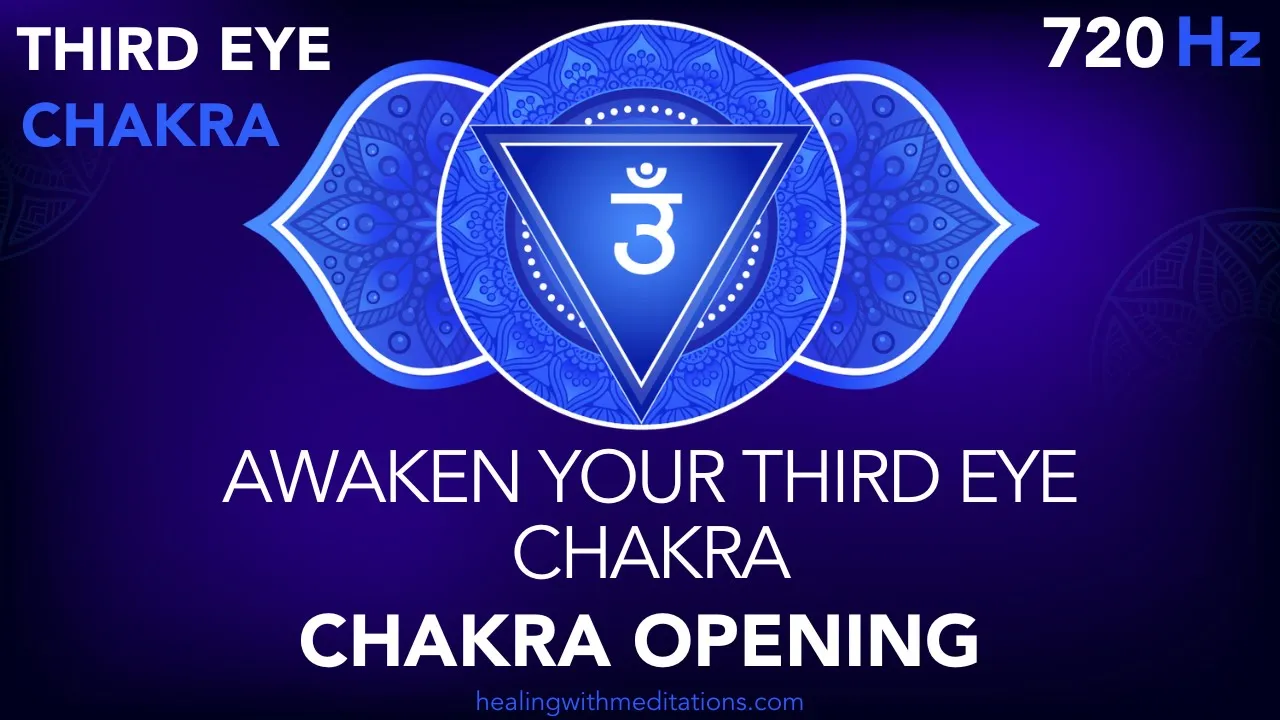
720 Hz and the third eye
In the chakra-tone chart, 720 Hz belongs to Ajna, the sixth chakra — the one associated with perception, intuition and dreams. It sits high in the series, which is the logic: higher chakra, higher tone.
720 Hz is a clear, bright tone, close to F#5. High tones are perceived as being “in the head”, which is part of why the mapping feels right — and also a reason to keep the volume low, since sustained high frequencies tire the ear faster than low ones.
What it will not do is open anything by itself. If that is what you are after, the third eye chakra guide → covers the practices that actually move it, with sound as one of five.
How to use a chakra frequency
- One chakra, one session. Working through all seven in twenty minutes gives each of them under three — enough to hear, not enough to matter.
- Quieter than feels right. Just above the room. Loud tones become something you endure.
- Headphones for the high ones, speakers for the low. Bass through a phone speaker is not there at all.
- Set a timer and do not touch it. The whole benefit is the not-getting-up.
- Same tone for two weeks before you judge it. Novelty feels like effect for about three days.
Questions people ask
Which chakra frequency chart is correct?
Neither, in the sense you mean. Both are modern and neither descends from the classical texts. Pick one and stay with it — consistency does more than correctness here.
Is there evidence that frequencies heal chakras?
No. There is evidence that slow, steady sound helps people relax and stay put, which is the mechanism most of the reported benefit runs through.
Can I play chakra frequencies while I sleep?
You can, but there is little reason to. Use it to fall asleep on a timer instead.
Do I need headphones?
For the higher tones yes, mostly for volume control. For binaural beats specifically, headphones are required — that effect depends on each ear getting a different tone.
What if a frequency makes me uncomfortable?
Stop it. High tones can trigger tension headaches or aggravate tinnitus, and there is nothing to be gained by pushing through. If you have tinnitus or any hearing condition, ask an audiologist before using sustained tones at all.
About this article. Chakras and chakra frequencies belong to spiritual and modern alternative practice, not to medicine. Nothing here is a diagnosis or medical, psychological or therapeutic advice, and no tone on this page treats any condition. Sound therapy is not a substitute for care — for hearing problems, tinnitus, headaches, or any health concern, please speak to a qualified professional, and never stop a prescribed treatment on the strength of something you read here.
Read this next
Boost Self-Confidence: 720 Hz Chakra Meditation Guide
Freedom from all the blockages that hurt my self confidence … I embrace life with peace, my Past, Present and…
13 min read720 Hz Third Eye Meditation: Unlock Intuition & Potential
Elevate your intuition & self-awareness with 720 Hz Third Eye Chakra Meditation. Unleash your potential…
19 min read720Hz Third Eye Chakra Meditation To Boost Emotional Intelligence
Boost your EQ with our Emotional Intelligence Meditation. Harness the power of the 720Hz Third Eye Chakra Freq…
10 min read